Imperium Galactica II | home
Review | The Races and Ships | Contact Us

Review
|
|
Those of us who seriously want to conquer the galaxy understand that it is a massive undertaking. We understand there are tremendous logistics involved in giving birth to an empire, and it's those growing pains we enjoy most. We adore researching the technologies that will form the skeleton of our cities and armies, negotiating (ha!) with our opponents to ensure the safe delivery of our incoming troops (surprise!) and carefully placing the smoke-belching production factories in positions where their offspring may easily line up to be the fist-driving muscle that smashes our enemies. Hell, for us the final victory is the most bittersweet -- it means there's nothing left to crush under our imperial heel.
To start a campaign, you choose between the three races. The Solarians are your typical human-descendant types; they don't do anything special, but they do it all. The Shinari are the sneaky weaklings who may be long on talk and short on starfleets but always seem to be able to pop up in unfortunate places -- like the command bridge of your fleet. Lastly, we have the never-mind-the-gab-here's-some-plasma-for-you Kra'hen. They aren't even capable of negotiation or trade, but you don't want to piss them off unless you've got phase-blasters stuffed into all their orifices first.
Each race has its own CD, which is packed not only with the epic storyline but also frequent, lengthy, beautifully rendered cutscenes. These movies gently push you along the plotline, informing you of important events as they happen and never forcing you to address them -- you're welcome to ignore the entire plotline and take your chances alone. But I wouldn't recommend it, since these events take a well done quad-X game [explore, exploit, ARGH DON'T REMEMBER THE REST - ed.] and launch it into new adventure terrain. Defeat a pirate lord, and he'll offer his daughter's hand in marriage, securing pirate-free spacelanes for the rest of the game. Accept his offer, and the daughter will challenge you to an even-odds space battle before she'll consent to marry you. You might get reports of a smuggler stealing money from your trade ports, forcing you to develop hyperspace technology sufficient to catch him. If you don't, not only will he make off with your tax money, but the traders will remember your laxity and frequent your planets less often. Every action you take has consequences, and frequently the obvious choice is not the best one. In one interaction, a trader offers a powerful new weapon -- the black hole generator -- but after purchasing the plans, you'll discover they're only the blueprints for a standard vacuum cleaner. Ow! It's these random events that make subsequent replays of the game nearly new experiences.
And replay you will, since the game is tough as hell to win your first time through. We're no stranger to complex strategy games, but IG2 is nearly overwhelming in its level of micromanagement. Mastering the intricacies of research, production, spying and diplomacy will save you from a humiliating defeat in the end. Fortunately there are many toggles that allow you to avoid management migraines. The time controls allow you to pause the game and issue orders or fast-forward to future actions. Battles can be auto-resolved, colonies can be set for styles of production (research, trade, military, etc.), ship production can be routed to a single planet and, for the most part, your empire takes care of itself. You'll love the auto-design feature, which allows you to retrofit all your ships with newer technology while they're still in the field, and the quick-research menu that lets you quickly select the next research project. Oddly enough, despite these busywork-killing options, the interface is more obtuse than necessary, and you'll find yourself consulting the manual frequently. In case you are slightly illiterate or simply lazy, there is a long tutorial that will hold your hand and explain every nuance of the game. The only thing you'll have no trouble understanding is the flashiest part of the game -- combat.
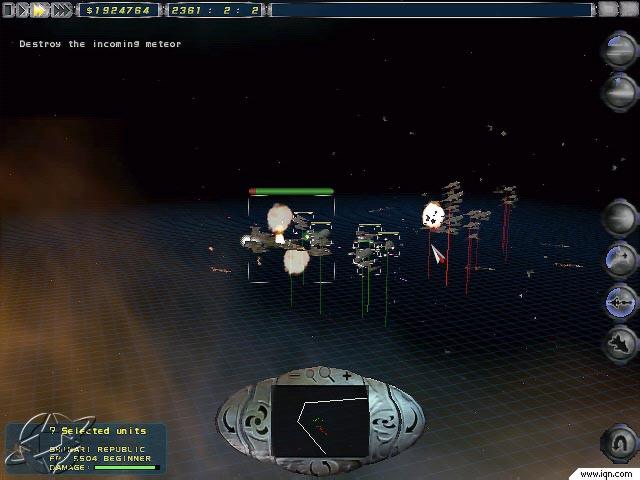
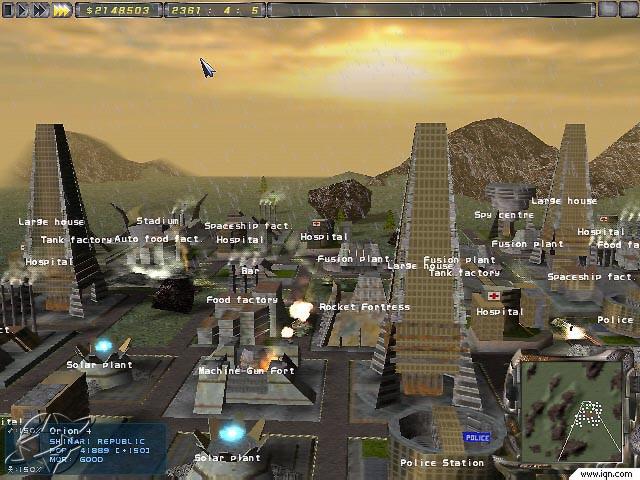
When empires go to battle in space, your view smoothly zooms from the galactic view to a more intimate local view with the ships involved laid out in selectable formations. If they are near a planet, the planet and its defenses will be included - space stations and ground-based cannons included. Despite the beauty of the battles, they are mainly composed of high school tactics - the bigger guys almost always win. Most battles end up as two lines of capital ships trading colorful fire and blowing up in worthy explosions with the screams of men as the soundtrack ("it's been a pleasure to serve... AHRRHHH!"). Homeworld this is not. You won't find much more in the ground battles around colony cities, which look and play like a poor man's Total Annihilation.
If fighting your friends is more your style, you'll be able to choose from any of the eight alien races in the game and meet up to eight of your friends through the built-in IRC (Internet Relay Chat) client. Although the retail version forced battles to be auto-resolved, the most recent patch enables realtime battles -- the meat and potatoes of multiplayer -- and allows each player to access the time controls.
One warning, however; a typical game will take four to 10 hours of your life, so be prepared to lose loved ones. Regardless of this danger, you'll sit back after your third game and stare at the sun coming up, with no way to avoid the obvious realization that this is what true space strategists have been waiting for since Master of Orion II, and you've loved every sleepless night of it.